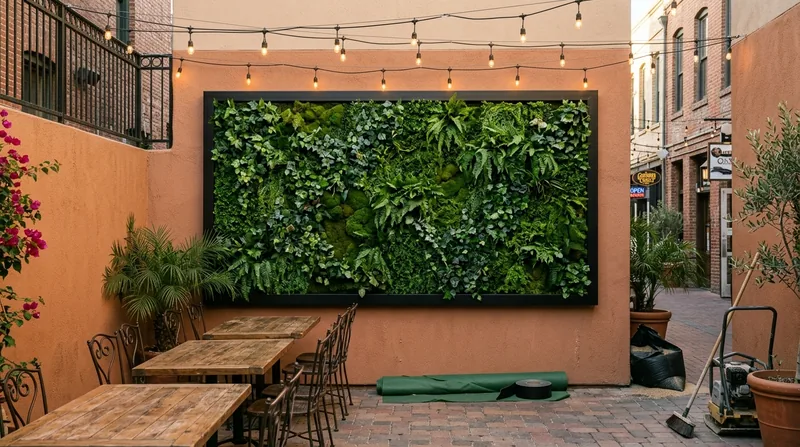




Artificial grass walls and vertical greenery transform blank stucco, concrete, and wood surfaces across San Diego into living focal points without the watering demands of climbing ivy or the maintenance of real climbing plants. From the Mission Hills garden walls framing Spanish Colonial courtyards to the modern minimalist backyard screens in Carmel Valley and the retail storefronts along the Gaslamp Quarter, vertical turf brings year-round green to spaces where natural vines struggle in the intense inland sun or salt spray near the coast. Unlike real climbing plants, which require consistent irrigation, pruning, and pest management in San Diego's hot, dry summers, artificial grass walls stay lush and uniform with zero watering and minimal upkeep, making them ideal for rental properties, commercial facades, and homeowners in HOAs with water restrictions or strict aesthetic rules.
Why Artificial Grass Walls Matter in San Diego's Climate and Real Estate Market
San Diego's Mediterranean climate, with soft marine-layer mornings at the coast and hot, dry inland sun, creates harsh conditions for traditional climbing greenery. Real ivy and clematis demand consistent deep watering during the May-through-September drought season, regular pruning to prevent overgrowth on stucco and siding, and management of spider mites and scale insects that thrive in the heat. Property managers, HOAs, and homeowners increasingly turn to artificial grass walls because they eliminate watering altogether, require no seasonal maintenance, and maintain a uniform, polished appearance year-round, even in full sun or deep shade.
- We install synthetic turf on vertical surfaces including stucco garden walls, wood privacy fences, metal trellises, and commercial building facades throughout San Diego, La Mesa, Poway, and Coronado.
- Artificial grass walls absorb no water, shed rainfall instantly, and resist salt spray, UV degradation, and temperature swings from 55F marine mornings to 95F inland afternoons.
- HOAs and property managers use vertical turf to enforce uniform aesthetics without relying on tenants or residents to maintain live plants or comply with watering schedules.
- Residential applications include screening unsightly utility areas, creating privacy from neighboring properties on tight urban lots, and adding green to balconies and rooftop edges where real plants wilt in reflected heat.
- Commercial properties use artificial grass walls as branded green backdrops for outdoor dining, retail storefronts, and office courtyards that photograph well and never look neglected.
Vertical turf installation requires specialized substrate preparation, proper drainage, and UV-rated products engineered to hold their color and texture on vertical surfaces where gravity and weather stress seams more than horizontal lawns.
Local example: A North Park Craftsman bungalow with a narrow side yard between two stucco walls used a 6-foot-high artificial grass wall to screen the AC unit and meter box from the street view, adding curb appeal without watering or pruning. The installation took one day and required no permits because no structural modification was made to the wall itself.
How We Install Artificial Grass Walls in San Diego: Process and Technique
Vertical turf installation differs fundamentally from ground-level artificial grass because every seam, edge, and fastener must resist gravity, wind, and water infiltration without visible support hardware. We begin with a site assessment of the existing wall surface, its angle, sun exposure, and drainage path. If the wall is wood, stucco, or metal, we prepare the surface by cleaning, repairing any damage, and installing a moisture barrier to prevent water from pooling behind the turf. We then secure a rigid or semi-rigid substrate, typically aluminum frame or plywood backing, and attach the turf using commercial-grade adhesive and stainless steel fasteners at the top and sides so no fastener is visible from the front.
- We assess the wall surface, angle, sun exposure, and existing drainage to determine substrate type and fastening method.
- We install a moisture barrier behind the turf to prevent water pooling and mold growth on the wall surface.
- We secure a backing substrate, typically aluminum or treated plywood, and prime it with a bonding agent compatible with the turf adhesive.
- We cut and fit the turf to the exact dimensions of the wall, accounting for seams, corners, and any protrusions or openings.
- We apply commercial-grade polyurethane or silicone adhesive rated for outdoor vertical use and press the turf firmly into place.
- We seal all seams using UV-stable seam tape and adhesive, then test drainage and water runoff to confirm no water pools behind the installation.
The entire process typically takes one to three days depending on wall size, substrate condition, and seam complexity. We use products engineered for vertical installation, with higher face weight and shorter pile height than ground turf to resist sagging and maintain appearance under constant gravitational stress.
Coronado example: A beachfront property owner installed a 12-foot-wide by 8-foot-tall artificial grass wall along the side of a guest house to screen the view into a neighbor's bedroom window. We used a UV-rated product with reinforced backing and stainless fasteners at the top, sealed every seam with commercial-grade tape, and confirmed drainage before finishing. The wall has held up through three years of salt spray and intense sun with no color fade or seam separation.
Installation Methods and Substrate Options for Vertical Turf
| Substrate Type | Description | Best For |
|---|---|---|
| Aluminum Frame | Lightweight extruded aluminum frame with plywood or composite backing, bolted to existing wall structure. | Tall walls, commercial facades, and installations requiring no adhesive contact with the original wall surface. |
| Treated Plywood | 3/4-inch pressure-treated or composite plywood primed with bonding agent, fastened to studs or existing wall frame. | Residential walls, fences, and trellis structures where direct adhesive application is acceptable. |
| Direct Adhesive Application | High-strength polyurethane or silicone adhesive applied directly to clean, primed stucco or concrete surfaces. | Solid stucco or concrete walls in good condition where substrate installation is impractical or undesired. |
| Modular Panel System | Pre-fabricated turf panels mounted on lightweight frames, interlocked or bolted together for rapid installation and future removal. | Rental properties, temporary installations, and commercial applications requiring reconfiguration or removal without wall damage. |
Each substrate type carries different costs, installation time, and permanence. Aluminum framing costs more upfront but enables future turf replacement without disturbing the original wall. Direct adhesive application is fastest and least visible but commits the turf to permanent bonding. We recommend the method based on wall condition, permanence goals, and budget during the free site estimate.
Artificial Grass Walls and Vertical Greenery Cost in San Diego: What to Expect
Artificial grass wall installation in San Diego typically starts at $18 per square foot for basic installations on existing sound surfaces using standard turf and direct adhesive application. Costs rise with wall height, substrate complexity, seam count, product grade, and site access. A 100-square-foot wall (10 feet wide by 10 feet tall) on a simple stucco surface may cost $1,800 to $2,200. A 300-square-foot commercial facade with multiple seams, aluminum framing, and premium UV-rated turf can run $6,500 to $9,000. Factors affecting the final price include the existing wall condition, whether substrate preparation or repair is needed, the turf product selected (face weight and pile height), seam count and complexity, and accessibility for installation equipment.
We always provide a written estimate after a site visit, breaking down turf cost, substrate, labor, and any wall prep required. Getting two or three estimates from different turf installation companies gives you confidence that your price is fair and that the scope is clear. See our pricing page for detailed cost ranges and factors that move the estimate up or down.
Cost example: A 150-square-foot wall in Encinitas (8 feet tall, 18 feet wide, two seams) on existing stucco cost $2,850 using commercial-grade turf, direct adhesive, and seam sealing. The same wall with aluminum framing and premium product cost $4,200. The difference reflects substrate durability, turf grade, and labor for more complex installation.
What to Look for When Hiring a Turf Installation Company Near San Diego
Hiring the right turf installation company near San Diego requires checking the same credentials and practices you would use for any contractor: proof of insurance, a written specification of the turf product and installation method, local references, and photos of finished work. Ask any company you interview to provide a certificate of insurance naming general liability and workers' compensation, and a written spec that names the turf product, face weight, pile height, substrate type, adhesive brand, and fastening method. Request references from recent vertical turf installations in your neighborhood or similar climate, and ask to see photos of seams, top edges, and drainage details at least six months after installation to confirm no separation or color fade.
- Verify the company carries general liability and workers' compensation insurance and request a current certificate naming your address as the job location.
- Ask for a written specification that names the turf product, face weight, pile height, substrate type, adhesive, and fastening hardware before work begins.
- Request references from at least two completed vertical turf installations in San Diego or nearby, and ask how the walls have held up over time.
- Review photos of finished work showing seams, top and bottom edges, corners, and drainage paths to assess quality and attention to detail.
- Clarify whether the company offers a workmanship warranty on the installation and what it covers if seams separate or adhesive fails within the first year.
- Confirm that the company will obtain any required permits for structural work or will coordinate with your contractor if permits are needed for wall modification.
A reputable turf installation company will spend time on site assessing your wall, answering technical questions, and explaining why one substrate or turf product is better for your situation than another. If a company quotes over the phone without a site visit or refuses to provide a written spec, look elsewhere. Contact us at (619) 831-6744 for a free estimate and we will walk you through the process, answer all your questions, and provide a detailed written proposal before any work begins.
Artificial Grass Walls & Vertical Greenery in San Diego: Pricing Guide
| Service | Price | Details |
|---|---|---|
| Basic vertical wall installation | Starting at $18/sq ft | Direct adhesive application on existing stucco or concrete, standard turf, one or two seams, no substrate preparation required |
| Wall with substrate framing | Starting at $22/sq ft | Plywood or aluminum frame installation, moisture barrier, commercial-grade turf, multiple seams sealed with UV-stable tape |
| Commercial or large-scale facade | Starting at $25/sq ft | Premium UV-rated turf, engineered substrate, stainless fasteners, complex seaming, drainage verification, and extended warranty |
| Wall repair or seam replacement | Starting at $800 | Partial turf replacement, seam re-sealing, adhesive refresh, or small sections of separation or fading addressed on-site |
| Estimate and consultation | Free | Site assessment, product recommendations, substrate evaluation, and detailed written proposal with no obligation to book |
Indicative pricing, the exact cost depends on square footage, finish, and site access. Free personalized estimate within 24h at (619) 831-6744.


